Alexandrian Pythian Games Issue
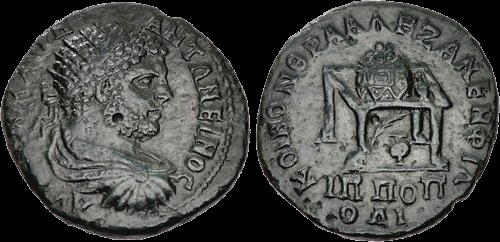
THRACE, Philippopolis. Caracalla. AD 198-217. Æ (36mm, 25.05 g, 7h). . Struck AD 214-215. Laureate, draped, and cuirassed bust right / Prize crown, inscribed ΠYΘIA and surmounted by balloting balls, set on table in perspective right; palm frond and urn below. Cf. Klose & Stumpf 195; Mouchmov, Philippopolis 377; cf. Varbanov 1420. VF, green patina, smoothed with some details enhanced.
History of Balloting
In ancient Greece, the dicasts (members of high courts) voted secretly with balls, stones, or marked shells. Legislation was enacted in Rome in 139 BC establishing a system of secret voting. Long before the passage of this law, however, questions sometimes were decided in Rome in public meetings by means of the ballot. Colored balls were used as ballots during the Middle Ages. This form has survived to modern times, particularly in clubs or associations in which voting decides the question of admitting or rejecting proposed new members. Each voter receives two balls, one white, indicating acceptance, and the other black, indicating rejection; they are then deposited secretly in appropriate receptacles so as to indicate a favorable or unfavorable decision. In some organizations, candidates for admission are rejected if any black balls are found among the white balls.
Apollo's sacred precinct in Delphi was a panhellenic sanctuary, where every four years, starting in 586 BC[4] athletes from all over the Greek world competed in the Pythian Games, one of the four panhellenic (or stephanitic) games, precursors of the Modern Olympics. The victors at Delphi were presented with a laurel crown (stephanos) which was ceremonially cut from a tree by a boy who re-enacted the slaying of the Python.[4] Delphi was set apart from the other games sites because it hosted the mousikos agon, musical competitions.[2]
Acquired CNG 93 Lot: 755
Fantastic! Very interesting reverse and one I've never seen before. Do you have an explanation of what it is, how it works, or what it represents? Note: I too have encountered some trouble with this program when it tries to handle quote marks or parenthesis characters. You can change them to something that works better. I hope to hear more about this gem. It's nice obverse too with a particularly malevolent portrait of an evil emperor. JM