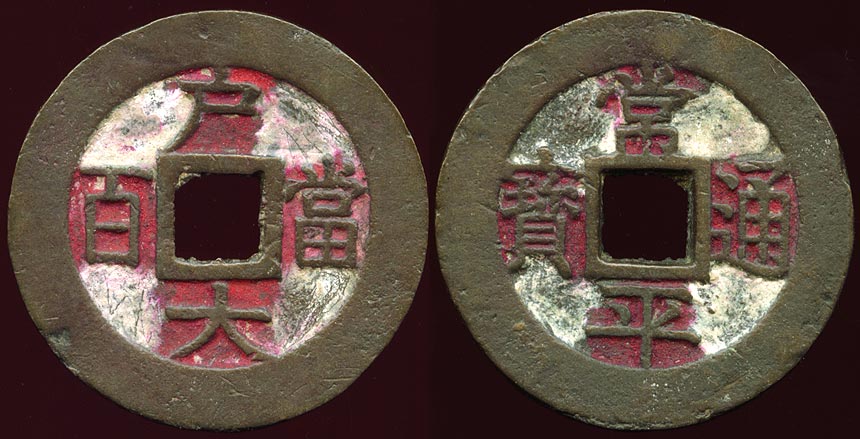
Scarce and authentic example of the colored background ('charmed') types that exist. More on these later. This one is copper, all of my other ones on display here appear to be bronze or brass alloys. Authentic examples exist in both metals. See KM 143. "Charmed" coins are/were often found in chatelaine and embedded in wooden family chests or treasury boxes.
Korean Chatelaine, an amazing combination of ribbons, amulets, and cash coins collected over a period of time by the wealthy Korean families and given to the bride on her wedding day. These were then kept hanging in the women's quarters of the house. Most of the chatelaine are quite fragile and have either completely disintegrated, or been taken apart over the years. The few surviving pieces are usually over 150 years old and quite rare. For more info on Korean Wedding Charms and Chatelaine see this: https://en.wikipedia.org/wiki/Korean_numismatic_charm
39.5 mm; 23.5 gm. In this photo has the Obverse/Reverse images are flipped.
Sang P'yong T'ong Bo, Hojo Treasury Department
Korea, ca 1866. Obverse Image: Four Chinese characters read top, bottom, right, left Obverse Text: Romanization: SANG / P'YONG / T'ONG / BO (Translation: Always Even Currency). Reverse Image: Character for Hojo Treasury Department at top, denomination read right, left, bottom. Reverse Text: Romanization: HO / TANG / BAE / CHON (Translation: Character for Hojo Treasury Department, worth one hundred).
This is a One Hundred Mun ("Value Hundred" tangbaekchon or dangbaekjun [sang pyong tong bo] coin.
The One Hundred Mun is the only denomination of sang pyong tong bo coinage for which accurate mint records exist. These coins were first cast by the Treasury Department on December 12, 1866 and put into circulation beginning January 15, 1867. The last coin was produced on June 16, 1867 which means these coins were cast for only 172 days. A total of 1,784,038 "One Hundred Mun" coins were cast by the government.
In general the One Hundred Mun coins minted by the government have a diameter of 40.6 mm, a thickness of 2.8 mm and a weight of 25.1 grams. There are about 50 varieties of the 100 Mun coins with differences so slight (character stroke style, size, etc) it is hard for a Westerner to discern. See my other examples here in the Moneta Museum.
Finally! An excellent work on Korean coins in English. It also describes the entire history of Korea in relation to their coinage. Past erroneous information is corrected and details of varieties are clearly illustrated. This is an amazing resource for numismatists and collectors. I thank Calvin Taehun Jin at Arirang Numismatics, and you will too. Read and Free Download "Coinage of Late Modern Korea" at this: https://arirangnumismatics.wordpress.com/coinage-in-late-modern-korea/
VIEW & DOWNLOAD Korean Coin and Charm Articles:
A Survey of Korean Coins - Joseph E. Boling: Korea - A Numismatic Survey - Boling
Korean Charms and Amulets - Starr
https://groups.io/g/Moneta/files/Moneta%20Library/Korean%20Charms%20&%20Amulets%20-%20Starr.pdf
German Coin Techniques in Korea - Won Yu-Han
German Coin Techinques in Korea - Won Yu-Han
Rulers of Korea
Rulers of Korea
Picture Album of 100 Korean Amulets
https://groups.io/g/Moneta/files/Moneta%20Library/Picture%20Album%20of%20100%20Korean%20Amulets%20-%20Greenbaum.pdf
Comments
No comments yet
Approved comments will appear here.
Log in to comment.