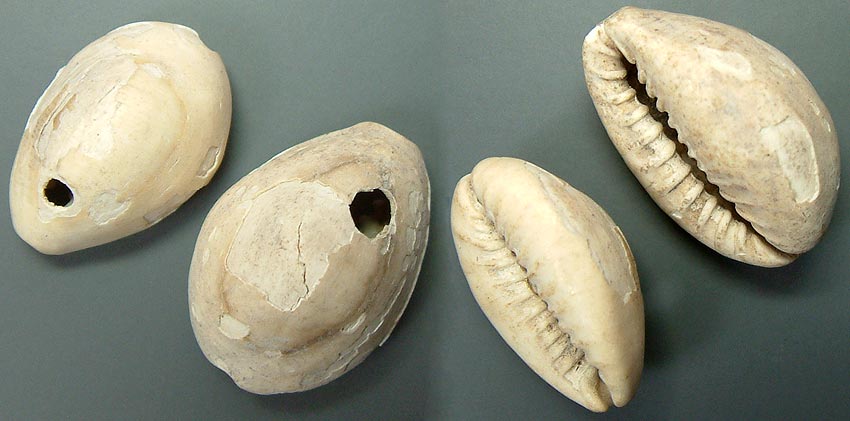
These smoother shaped (more rounded) represent Cypraea annulus used as money in China. See the listing for a fresh C. moneta for additional information.
These examples are in typical condition. They are calcified and annual build layers are flaking off. Here starts the long Chinese tradition having a hole in their money to facilitate stringing and grouping of value. See this museum for other examples where the back is broken or filed out, thus providing a larger hole for easier stringing and more compact storage of value. One can imagine a progression of using the C. moneta & C. annulus shells as a medium of exchange then drilling holes for stringing, followed by filing out the backs for a more compact string. All hard money eventually under goes degridation and inflation as it becomes too scarce and valuable - thus cowry imitations. Greshams Law in action with ancient Chinese shell money!
Moneta Library has articles on Cowries to VIEW and DOWNLOAD:
The Worlds's First Money, Chinese Cowries and Their Imitations - by Ted Puls: The Worlds Oldest Money Cowries Ted Puls
Cowries - Bob Reis: COWRIES Reis
Origin of Cowries in Ancient China - UofPa: Origin of Cowries in Ancient China
Metallic Cowries - Royal Asiatic Society: Metallic Cowries - Royal Asiatic Society
Nice Video on Cowrie history: http://tinyurl.com/CowrieVideo
An excellent article in ANA's "Numismatist" magazine, Oct 2017 > http://onlinedigitalpublishing.com/publication/?i=440085&ver=html5&p=40
SEE how far back in time decorative sea shells were important to prehistoric man at his : https://www.sciencedaily.com/releases/2009/05/090505163021.htm
Interested in Primitive Money? Then check out this YouTube video created by Kagins Auctions featuring Bob Leonard and Charles Opitz upon the massive sale in March 2021. Click this: https://www.youtube.com/watch?v=9MIKxfbAaZg
Comments
No comments yet
Approved comments will appear here.
Log in to comment.