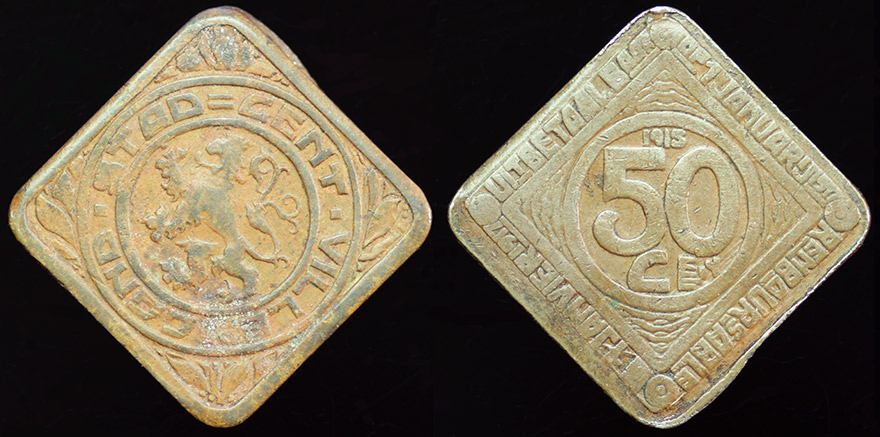
This is an example of the "Thick 50" variety of the 50 Centimes of WWI German Occupied Ghent , Belgium. See the "Thin 50" variety here in the Moneta Museum. I'm writing a paper on my research of this series. What's clear is that the original idea was to strike on iron planchets that had been layered in brass and iron. That didn't work out so the method used was to electro-plate brass and copper on 'mild steel'. I've never seen one that shows any rust on the 'iron' edges,, which seems impossible if you've seen a typical WWI issue in iron. Error coin, or one of the early types in all copper? Some have stated the opinion that a 50 Centimes with copper plating on both sides represents a counterfeit (see NIB Sep 1975, Robert Talisman), this may be true, but all other details of the execution of this piece appears to be a true coin. It seems far more believable that shortages of plating metal, documented in my monograph, are responsible for a two sided copper plating.
OB: Lettering: .STAD=GENT. VILLE DE GAND; [Translation: City of Ghent]
RX: UIT BETAALBAAR ° OP 1 JANUARIJ 1917°; at center 1915 50 CEN (unclear); REMBOURSABLE ° LE 1 JANVIER 1917 °; [Translation: Convertable (reimbursable] on 1 January 1917. 512,000 struck of both varieties.
VIEW & DOWNLOAD:
Here's a link to the article I wrote for the "NI Bulletin" [Sep/Oct 2023], the bimonthly publication of Numismatics International. It explores the conditions of the WWI minting of these unusual emergency coins of Ghent, Belgium - click this: Ghent Belgium Emergency Coins 1915
Belgium
Belgium - Ghent 50 Centimes 1915, Thick type, ALL Copper
Click or tap the photo to zoom and browse.
Comments
No comments yet
Approved comments will appear here.
Log in to comment.